
Goodbye Iceland
By the time we transitioned from the self-drive tour of Iceland to the Viking Cruise we were ready for someone else to take on the decisions. And after wheeling our bags in and out every night we also really appreciated the ‘unpack once’.
Our first few days of the cruise were mostly in Iceland’s outer parts. Whereas our self-drive was counterclockwise, the cruise went clockwise, as follows:
Day One: Reykjavik
While I soaked up the health-giving minerals at the blue lagoon JR went on an 8 hour photographic expedition of the city and surrounds.
Random facts that I collected today were:
· Average Icelandic salary is 745,000 Icelandic krona per month (circa AUD 9K = $108k annual). Tax = 31% to 46%. Living expenses are high. A pizza = $50.
· Of the 12 humans that have ever walked on the moon, 9 first touched down and trained in Iceland, including Neil Armstrong.
· Iceland’s handball and football teams have put the country on the map. Also the famous ‘Match of the century’ chess game during the Cold War pitting American (Bobby Fischer) against Soviet (Boris Spassky) in 1972, Fischer taking it out, 12.5 to 8.5.
· There are 65 golf courses in Iceland. Many incorporate lava fields into their design.
· To preserve the purity of the Icelandic horses that have never been exposed to diseases such as equine influenza and equine herpes, no horses can ever be imported into Iceland and those that leave cannot come back!
Day Two: Isafjodur (West) pronounced ‘Eassa Fee A Door’
· Very remote.
· Fishing (Atlantic cod, haddock, pollock, greenland shark for oil – 1/3rd of their body can produce 114 litres of oil) used to be the main industry, best natural harbour in Iceland, it has a natural gravel spit.
· Lighthouses are orange in Iceland so they show against the snow
· There’s a university here aimed to keep kids at home. Our guide studies Coastal Management here. He is French and says most his fellow students are from Canada, USA and Europe. Not many locals, despite the good intentions.
· We crossed the Arctic circle! JR did a polar plunge to celebrate. I had a glass of bubbles.
Day Three: Akureyri (North) – pronounced Ack-err-ray-ree
· We went to what used to be the most northern botanical gardens, now the second (superseded by Norway). A nip under four hectares of plants that can survive the challenging climate, including the national flower of Iceland, the mountain avens, arctic and woolly willows, dwarf birches and various tough terrain ground-covers. Additionally, and surprisingly, sunflowers, dahlias, roses, junipers, rohans and poplars.
· I met a local from here who said the ‘Forest Lagoon’ on the outskirts of Akureyri, was the best hot pool lagoon in Iceland. I drove past on a bus but for obvious reasons, was unable to stop. It looked amazing from a whizzy ‘fly-by’ perspective. I’ll have to come back.
Day Four: Seydisfjodur (East) pronounced ‘Say This Fee A Door’
· This very remote spot with a population of 750, is known for, of all things, ‘Yarn Bombing’ which is graffiti and street art using wool, a long cry from the villages early start as a herring fishing port. Seydisfjodur was also the first place to connect Iceland to Europe ‘telecommunicationally’ via undersea cable.
· JR went on a bike ride while I went to the Skarlanes bird sanctuary and I had a magical day with puffins and arctic terns, a day I’m quite sure I’ll never forget (some what referred to in the last Iceland road trip blog).
· A funny thing – Our bird sanctuary guide said, when introducing the town (Seydisfjodur), ‘Say this Fee A Door’ and we all obligingly responded with ‘Fee A Door’ and she said, ‘No! Not ‘Fee A Door’, ‘Say This Fee A Door’….and we all said ‘Fee A Door’…and on it went till we all realised what had been ‘lost in translation.’ (Say this, was actually part of the name, not an instruction).
· That evening we left for what proved a very rocky voyage to the Faroe Islands, about halfway between Iceland and Norway.
Day Five: The Faroe Islands
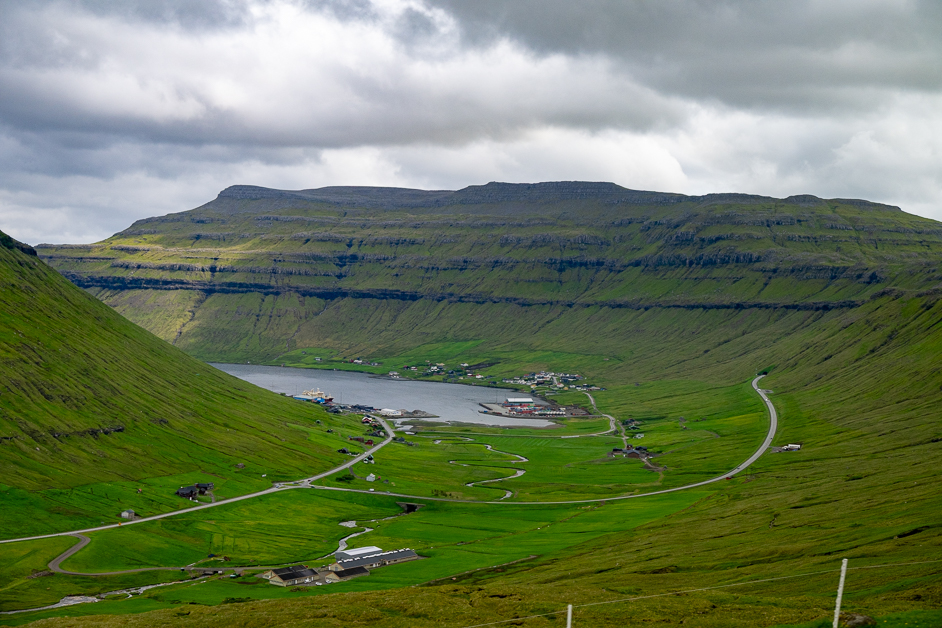
· We had an early (5am) arrival into Torshavn, the capital of The Faroe Islands. Much older than Iceland – the volcanoes are no longer active but the landscape is dramatic and beautiful.
· The self-governing region of the Kingdom of Denmark comprises 18 islands, 55,000 people and 80,000 rather scruffy sheep who have developed a dual-coated fleece in adaptation to the harsh environment.
· Seven of the 18 islands are connected via bridge or tunnel. We travelled 45 minutes north by bus to the village of Vestmanna which is known for steep cliffs and bird colonies.
· At Vestmanna we boarded a boat piloted by an extremely skilled skipper who took us out into the open waters and around the base of the cliffs into grottos and caves where the ocean was slapping and various birds including guillemots, gannets, skuas, shags, petrels and a couple of puffins were nesting.
· The steepness of the cliffs was the real attraction with sheer rock faces that somehow the sheep managed to clamber over. Or not. The bus driver told us the sheep are often found floating in the seas below.
· The sheep that survive and go on to meet a similar but more predictable end, are used to produce a Faroese delicacy called ‘skerpikjot’. Its particular flavour is due firstly to the years of steep grazing which is said to produce a unique tang. This is further ‘enhanced’ (?) with a process that involves wind drying, fermentation and no refrigeration over a 9 month period. The end result is something that could be described as having a pungency sitting on the far right of a continuum that starts gently with blue vein cheese, sails pass toe jam and waves merrily while overtaking death. I politely declined.
· The bus driver also told us that a couple of years ago one of the 18 islands had a rat plague and they tried a ridiculous number of methods to get it under control. Success was finally achieved when they introduced two schnauzer dogs from Germany. I’m not sure that they were ‘miniature’ schnauzers but I’m sure our Pixel would like us to think they were.
· Back in Torshavn we walked through the old town which charmed us with its black tarred houses, white window frames and turf roofs. The turf roofs are back in vogue as they are quieter when it rains. As it does. Often.
· Funniest Faroe story goes to a conversation JR overheard at breakfast. Two gentlemen were exchanging their plans for the day. One man was explaining that he was looking forward to visiting the military museum and learning about the conflict and occupation. The second man looked confused and said he understood the Faroe Islands hadn’t much of a war record. To which the first man responded ‘Faroe Islands? God damn, I thought we were at the Falkland Islands.’ (!)
Farewell Faroe Islands….Next stop … the Norwegian Fjords.
[ngg src=”galleries” ids=”40,41″ exclusions=”733,723″ display=”pro_tile”]